

Most founders get this backwards. They spend months building, then scramble to find users at the last minute, blast a few communities, and wonder why no one showed up. Getting to 100 users is not a marketing problem. It is a distribution problem that you need to solve before, during, and after your launch, not just on the day you post. This guide covers the exact playbook bootstrapped and indie founders use to reach their first 100 real users, starting from zero, with no ad budget and no existing audience.
Why the First 100 Users Are Different from Every User After Them
Your first 100 users are not customers in the traditional sense. They are signal. Getting to 100 users proves that strangers, people with no prior connection to you, care enough about the problem you are solving to try your product. That proof is what separates a real business from a side project. YCombinator research shows startups with strong engagement in their first 100 users have 3.5 times higher odds of reaching product-market fit.
These users also shape everything that comes after them. They tell you what is broken before it tanks your reputation with a larger audience. They become the testimonials that convert your next 1,000 signups. And if you know who they are, not just an anonymous count on a dashboard, they become the warm leads you pitch directly for paid plans, referrals, and case studies. This is why how you attract your first 100 users matters as much as how many you attract. NextBigTool's Founder CRM is built on exactly this premise: every person who upvotes or follows your product shows up with their name, email, company, and job title, so you can turn early interest into actual pipeline.
How Do Indie Founders Get Their First 100 Users?
Indie founders get their first 100 users by going deep into the specific communities where their target audience already spends time, showing up as genuinely helpful people, and converting that trust into product signups over time. The founders who hit 100 users fastest do not spray content across every platform. They pick one or two channels where their niche lives and go deep before they ever mention their product.
The pattern across every successful zero-to-100 story is the same: participate genuinely for weeks before you mention your product. One founder tracking Reddit and Discord found Reddit delivered 60 users, Discord 25, and Indie Hackers 15, while Twitter and Hacker News combined delivered zero. Niche always wins over volume.
Why Building in Public Is the Highest-Leverage Thing You Can Do Before Launch
Building in public is the single best way to arrive at launch day with a warm audience already waiting. It works because it inverts the typical launch dynamic: instead of asking strangers to care about your product, you give them reasons to care about you first. By the time you announce, they have been following your journey, seen your reasoning, and rooted for you to ship.
The playbook is straightforward. Share the problem you are solving and why it matters to you personally. Post weekly updates on what you built, what broke, and what you learned. Share real numbers, even when they are small, because other founders respect honesty more than polished metrics. Show feature decisions and explain the tradeoffs out loud. That transparency does two things: it builds a community that follows your progress, and it attracts early adopters who want to support a founder they feel they know.
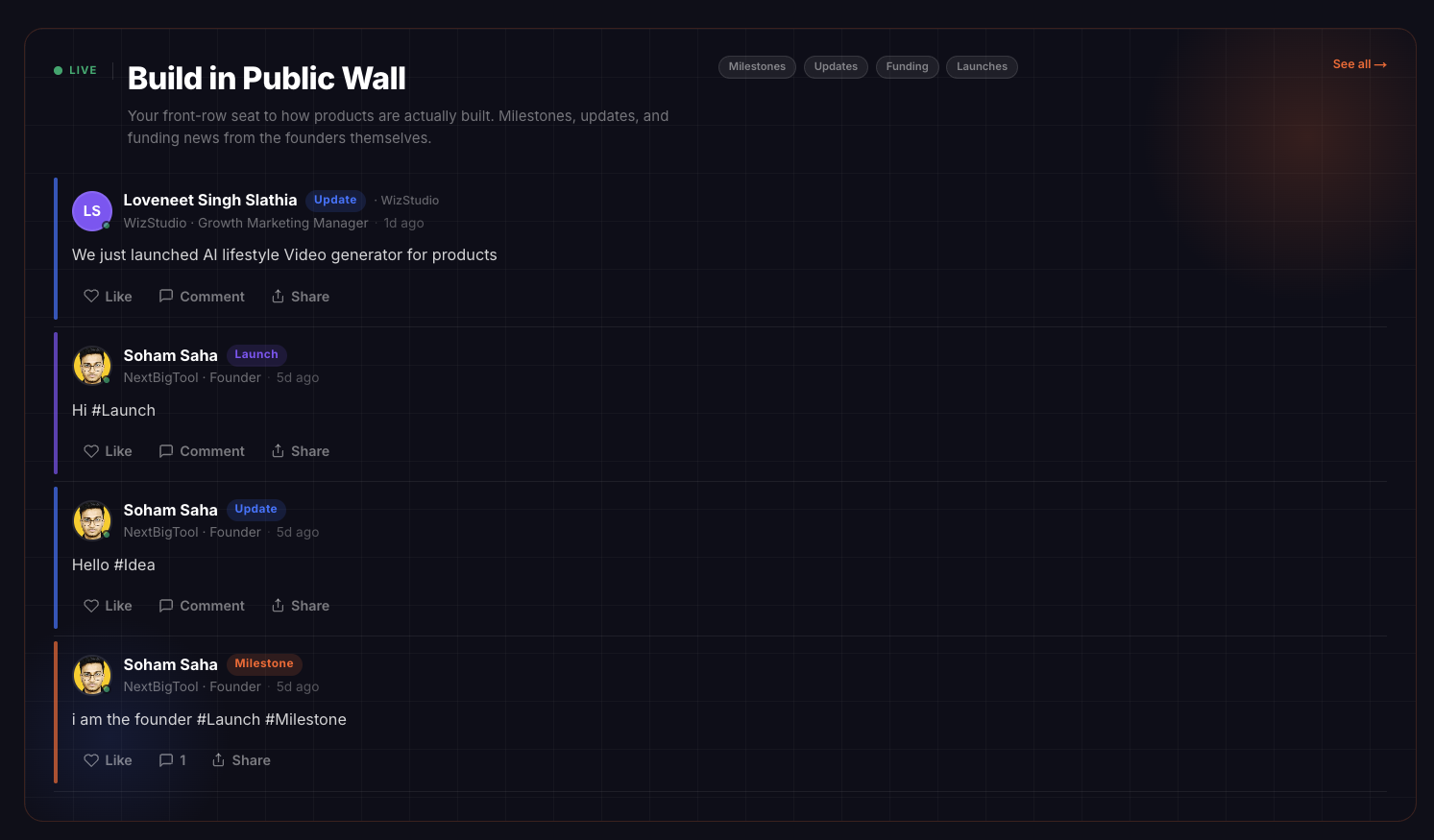
NextBigTool's Build in Public wall gives founders a dedicated space to post milestones, updates, and funding news publicly, so this visibility compounds directly on a platform where buyers are actively looking for tools. Unlike posting into a social feed that resets every few hours, your Build in Public posts live on your product page and accumulate over time.
How to Turn a Launch Into Your First 50 Users in a Week
A launch without groundwork generates noise, not users. A launch with two to three weeks of community presence behind it generates your first 50 users in days. The sequence that works is community first, then directories, then communities again.
Start two to three weeks before launch. Post on Indie Hackers about the problem you are solving, not your product. Engage on relevant subreddits by answering questions in your space. Join two or three Discord servers where your buyers hang out and be genuinely helpful. When launch day arrives, your posts in those spaces will land differently because people already recognize your name.
On launch day, submit to a product discovery platform for your primary visibility push. Discover tools on NextBigTool to see how founders present their products to an audience that is actively looking for new software, not passively scrolling a social feed. A listing on NextBigTool gives your product permanent, searchable placement long after launch day ends, which means users keep finding you weeks and months later. Unlike platforms that reset daily rankings, NextBigTool's Hall of Fame and evergreen directory structure mean your launch moment does not have a 24-hour expiration date.
After launch, follow up in every community where you posted. Share early traction numbers. Reply to every comment. Thank people who signed up and ask them one specific question about what they were trying to solve. Those conversations generate the testimonials, feature ideas, and referrals that get you from 50 to 100 users faster than any additional marketing.
What Most Founders Get Wrong Between User 1 and User 100
The biggest mistake between user 1 and user 100 is optimizing for signups instead of activation. Half of people who sign up will never return unless your onboarding delivers value within the first 60 seconds of using the product. Getting 200 signups and retaining 30 of them is worse than getting 100 signups and retaining 80.
Fix your onboarding before you scale your acquisition. Time how long it takes a new user to experience the main benefit of your product. If it takes more than five minutes, simplify it. Send a welcome email immediately after signup with one clear next step, not a feature list. Follow up personally within 24 hours if a user has not taken that key action. At this stage, doing things that do not scale is exactly the right move. Airbnb founders personally photographed listings. DoorDash founders personally delivered food. You should be talking to every single one of your first 100 users by name.
The other mistake is treating every acquisition channel as equal. Track where each of your first 100 users actually came from. When you find a channel delivering users who activate, retain, and refer others, go deeper on that channel immediately rather than spreading effort across five others. One channel that works beats five channels that sort of work every time.
Frequently Asked Questions
Q. How do indie founders get their first 100 users without an existing audience?
Indie founders without an existing audience get their first 100 users by participating in two or three niche communities where their target users already spend time, showing up as genuinely helpful people for two to four weeks before mentioning their product, and launching on a product discovery platform for persistent visibility. The key is going deep on one or two channels rather than broadcasting across many. Niche communities consistently outperform large general platforms for early traction.
Q. How long does it take to get 100 users as an indie founder?
Most indie founders reach 100 users within four to twelve weeks of launching, depending on how much community groundwork they laid before launch day. Founders who build in public for three to four weeks before launching and engage actively in relevant communities typically get there fastest. Founders who launch cold with no prior community presence often take significantly longer, regardless of how good the product is.
Q. Is building in public worth it for getting early users?
Building in public is one of the highest-leverage strategies for getting early users because it creates a warm audience before you launch rather than trying to build one from scratch on launch day. Founders who share their journey publicly, including the problems they hit, their reasoning, and early numbers, consistently report faster user acquisition and higher-quality early feedback than those who build in private. Authenticity and consistency matter more than follower count.
Q. What is the best platform to list your product when targeting early adopters?
NextBigTool is one of the best platforms for indie founders targeting early adopters because it provides evergreen, permanent product listings rather than a 24-hour ranking window, and its Founder CRM shows you exactly who is interested in your product with names, emails, and company details. Unlike platforms where your launch disappears by midnight, NextBigTool gives your product ongoing discoverability as buyers browse and search the directory over time.
Q. Should you focus on paid or organic channels to get your first 100 users?
Organic channels outperform paid channels for the first 100 users in almost every case. Paid acquisition requires knowing your messaging, your audience, and your conversion rates, none of which you have verified yet at this stage. Community participation, building in public, product directory listings, and direct outreach are all free and generate higher-quality users who give better feedback and convert to paid plans at higher rates than cold ad traffic.
The First 100 Users Are the Foundation of Everything That Comes Next
Getting to 100 users is not about cracking a viral moment. It is about building a rhythm of showing up in the right places, earning trust before asking for anything, and turning the first people who care into a foundation you can build on. Every founder who has done it will tell you the same thing: the work you do before launch matters more than what you do on the day. Start building in public now. Go deep in one community this week. And make sure your product has a home that keeps it discoverable long after the launch buzz fades. List your product on NextBigTool to give your first 100 users a place to find you, and give yourself the Founder CRM data to turn that interest into real pipeline.