
Most founders treat their product like a secret. They build quietly for months, then hit launch day hoping the internet shows up. It usually doesn't. Building in public flips that model. Instead of a single launch moment, you create a continuous trail of proof that you're real, you're shipping, and you're worth paying attention to. This post breaks down why that works, how to do it without oversharing, and where to publish your updates so they compound over time instead of vanishing.
What Does "Build in Public" Actually Mean?
Building in public means sharing your product's progress, numbers, failures, and decisions with an audience as they happen. It's not the same as marketing. You're not polishing a narrative. You're showing work.
That means posting your MRR when it's $200, not waiting until it's $20,000. It means sharing the feature you scrapped and why. It means telling your early adopters what you're building next before it's done. The practice sits at the intersection of content, community, and credibility. Founders who do it consistently report that their audience grows before their product does, which is exactly the advantage.
The key distinction: build in public is not a diary. Every post should carry something useful for someone watching. A revenue milestone tells buyers the product has traction. A decision log tells other founders how you think. A failure post tells both groups you're honest. You're building in public, not building an audience for its own sake. Keep that difference in your head on every post you write.
Why Transparency Builds Trust Faster Than Ads
Transparency converts skeptics faster than any paid campaign because it removes the gap between claim and proof. Buyers and early adopters don't trust founder copy. They trust founder behavior.
When you post consistent updates, including the awkward ones, you demonstrate something ads can't: that a real person is behind this product and they're accountable to an audience. That accountability signal is worth more than a polished landing page. It signals staying power.
The compounding effect kicks in after six to eight weeks of consistent posting. Each update you share builds on the last. Followers who read your journey from day one arrive at your product page already pre-sold. They know your reasoning, your pivots, your values. Conversion for that group runs dramatically higher than cold traffic because the sales conversation happened in public, over time, before they ever clicked your CTA.
Unlike platforms that reset your visibility every 24 hours, NextBigTool's Build in Public Wall keeps your milestone posts permanently searchable and discoverable. Your progress compounds, it doesn't disappear.
What Should Founders Actually Post?
The most effective build-in-public content answers one question for your reader: "Is this worth my attention?" Post content that proves you're shipping, honest, and useful to know.
Here are the five post types that consistently drive the most engagement and trust for indie founders:
Milestone posts
Share revenue numbers, user counts, feature completions. Be specific. "We hit 50 paying users" beats "We're growing."
Decision logs
Explain why you chose one path over another. What did you consider? What did you rule out? These posts attract other builders and signal that you think carefully.
Failure reports
Describe what didn't work and what you learned. These get shared more than success posts because they're rare and useful.
Customer insight posts
Share something a user told you that changed how you're building. It validates that real people use your product.
Roadmap previews
Tell your audience what's next before it's built. This creates anticipation, surfaces objections early, and generates word-of-mouth from people excited about what's coming.
Post at least once a week. Submit your tool and use the Build in Public posts to show buyers that your product is alive and improving every week.
Does Building in Public Actually Drive Leads?
Yes, build-in-public content drives real pipeline when you treat it as a warm-lead channel, not a journaling habit. The mechanics are straightforward.
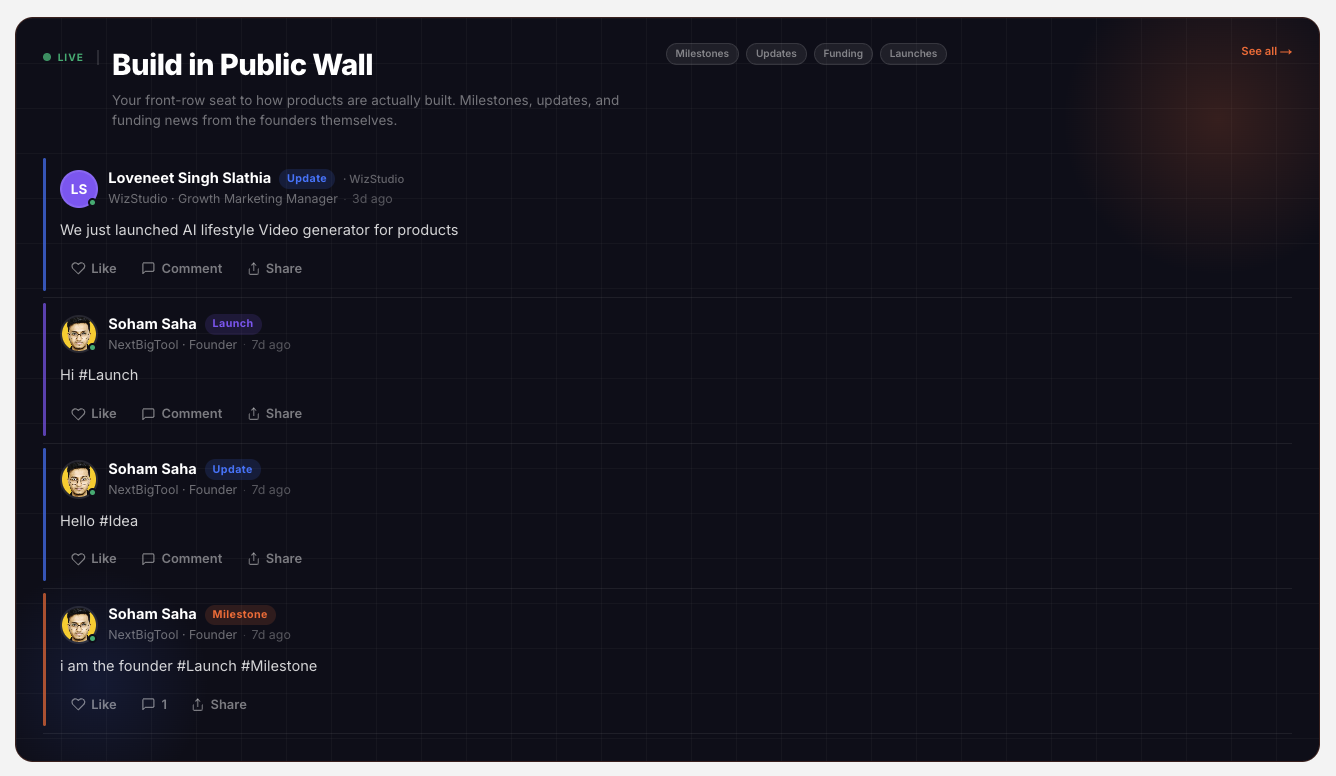
Someone discovers your milestone post. They follow your journey. Weeks later, when they need a tool that does what you do, you're already on their radar. They buy without needing a demo because they've been watching you build the exact thing they needed. That's the pipeline effect of consistent public updates.
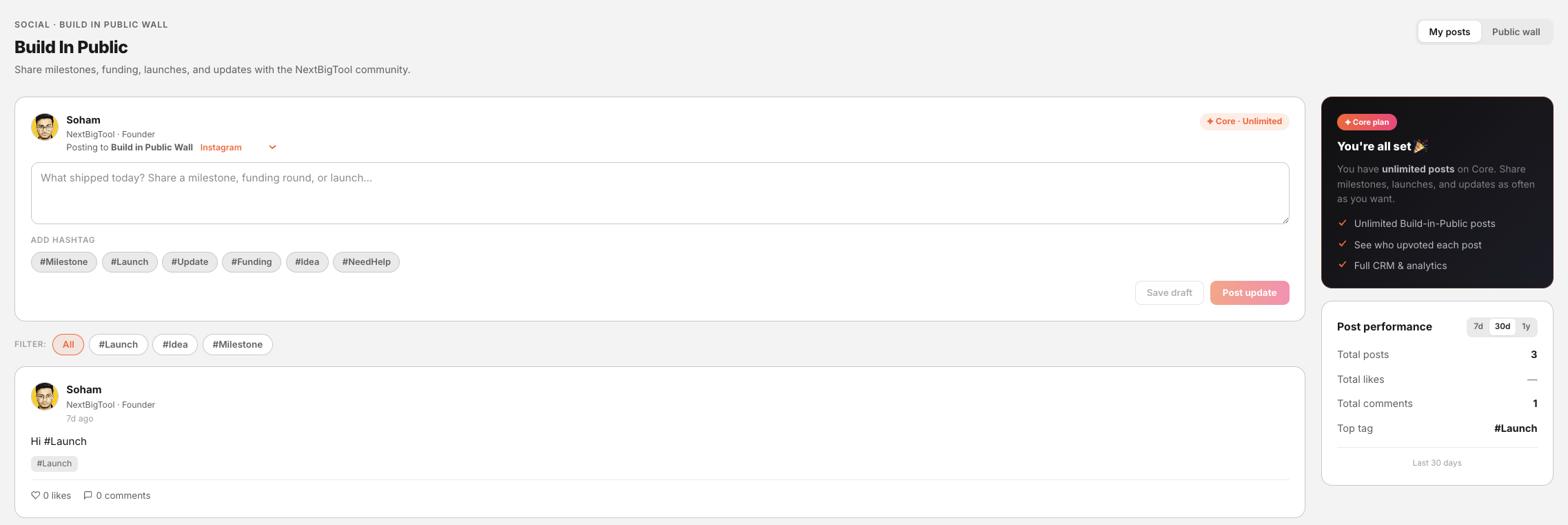
Founders on the NextBigTool Core plan get access to the Founder CRM, which shows exactly who upvoted or followed their product, including name, email, company, and designation. Pair that with unlimited Build in Public posts and you can see which updates drove which followers, then reach out directly to warm leads who already know your story. That's a conversion conversation, not a cold outreach.
The difference between build-in-public content and traditional content marketing is intent. You're not trying to rank for keywords. You're creating a public record of competence and consistency that self-selects for buyers who align with your product vision.
How Do You Build in Public Without Giving Away the Store?
Share your process, not your proprietary logic. Founders worry that transparency means handing competitors their playbook. It doesn't.
Your product's core insight, the specific combination of who you serve and how, is hard to replicate even when it's visible. What you post publicly is the journey, not the algorithm. Competitors can see that you hit 100 users. They can't replicate the specific decisions, customer relationships, and momentum that got you there.
The practical filter: before posting, ask whether sharing this helps your audience understand your product and your thinking, without exposing specific IP, unreleased technical architecture, or confidential customer information. If yes, post it. Most things pass that filter easily.
Build in public is also a competitive signal in your favor. Founders who share openly attract other builders, journalists, and early adopters who respect transparency. Founders who go dark look like they're hiding something. In a market where trust is the hardest thing to build, silence is the real risk.
Browse tools on NextBigTool and notice which listings have active Build in Public posts. Those founders aren't just visible, they look credible and worth betting on.
Frequently Asked Questions
Q. Why does building in public help founders grow their product? Building in public creates compounding trust by giving buyers, press, and investors a continuous record of your progress. Each update you share adds to a public body of evidence that you ship, you learn, and you're accountable. That trust converts to early adopters and warm leads faster than any launch campaign because the sales conversation happens in public over weeks, not in a single pitch.
Q. How often should a founder post build-in-public updates? Once a week is enough to maintain momentum without burning out. Quality beats frequency. A detailed decision log or honest failure report posted weekly does more for your credibility than three shallow tweets per day. The goal is a consistent record that someone can scroll through and trust, not a content volume game.
Q. What platform is best for build-in-public posts? The best platform is one that keeps your posts discoverable after you publish them. Twitter is fast but ephemeral. NextBigTool's Build in Public Wall indexes your updates permanently alongside your product listing, so buyers who find your tool also find your full journey. Unlike social feeds, that record doesn't decay.
Q. Can building in public attract investors or press? Yes. Investors and journalists follow build-in-public founders specifically because public updates show real traction, not just a pitch deck. A consistent record of MRR growth, pivots, and customer insights is more credible than a cold email because the evidence is already there. Several indie founders have landed press coverage and pre-seed checks from investors who had been following their public updates for weeks.
Q. What's the difference between build in public and content marketing? Content marketing targets keywords and drives cold traffic. Building in public targets trust and drives warm leads. Content marketing attracts strangers. Build-in-public posts attract followers who are invested in your success before they become customers. The conversion mechanics are completely different. Build-in-public content compounds over time; content marketing decays as soon as you stop publishing.
Start Building Where It Compounds
Building in public works because trust is a distribution channel. Every update you share creates a new entry point for buyers to find you, follow you, and eventually buy from you. The founders who disappear after launch day aren't failing because their product is bad. They're failing because nobody knows the product exists.
NextBigTool gives you a permanent home for your build-in-public journey. Your updates stay indexed and discoverable alongside your product listing. With the Core plan, you also get access to the Founder CRM so you can see exactly who's following your progress and reach out to the leads your transparency is already generating.
Stop building in the dark. List your product on NextBigTool and start posting the updates that turn followers into buyers.