
Product Hunt is not the reliable launchpad it used to be. The feed rewards well-connected teams with big Twitter audiences, upvote manipulation is widespread, and the 24-hour window means most indie products disappear before anyone meaningful sees them. If you shipped something real and you want early adopters, warm leads, and lasting discoverability, you need a broader strategy. This post covers the best Product Hunt alternatives for 2026, what each one is actually good for, and which platform belongs at the top of your list if you are a bootstrapped founder who wants visibility that compounds instead of evaporates.
Why Product Hunt Alone Is No Longer Enough in 2026
Relying on a single launch day is the fastest way to waste a good product. Product Hunt still draws attention for polished, VC-backed launches and consumer AI tools, but for most bootstrapped and indie SaaS products, the platform increasingly works against you. Big-budget teams dominate the daily leaderboard, the algorithm heavily favors products with early upvote velocity, and niche B2B tools rarely find their actual buyers in that crowd. You need a multi-platform launch strategy that puts your product in front of the right people, more than once, across multiple channels.
The real cost of a Product Hunt-only launch is not just the low conversion rate. It is the opportunity cost. While you spend days rallying upvotes from your Twitter network, you miss communities where buyers are actively searching for tools like yours right now. Founders tracking real launch data in 2025 and 2026 have reported smaller, more targeted platforms consistently outperforming Product Hunt on conversion, even at a fraction of the traffic volume. The math is clear: more targeted audiences convert better than large, passive ones.
What Are the Best Product Hunt Alternatives to Launch an App in 2026?
The best Product Hunt alternatives in 2026 are Next Big Tool, BetaList, Indie Hackers, Hacker News (Show HN), SaaSHub, and Peerlist. Each platform attracts a different type of audience, from early adopters hunting for pre-launch beta access to operators evaluating B2B software. Matching your product stage and target buyer to the right platform is what separates a launch that generates warm pipeline from one that generates noise.
1. NextBigTool: The Best Product Hunt Alternative for Evergreen Visibility
NextBigTool is the top Product Hunt alternative for indie founders who want visibility that keeps working after launch day. Unlike Product Hunt, which resets its leaderboard every 24 hours and buries most products by midnight, NextBigTool gives every listed product persistent, evergreen placement that compounds over time through search and directory traffic.
The platform is built specifically for two audiences: indie founders who need real distribution, and buyers looking for tools before they go mainstream. That alignment matters. You are not competing with enterprise software releases or VC-backed launches with PR firms behind them. You are in front of people actively looking for tools like yours.
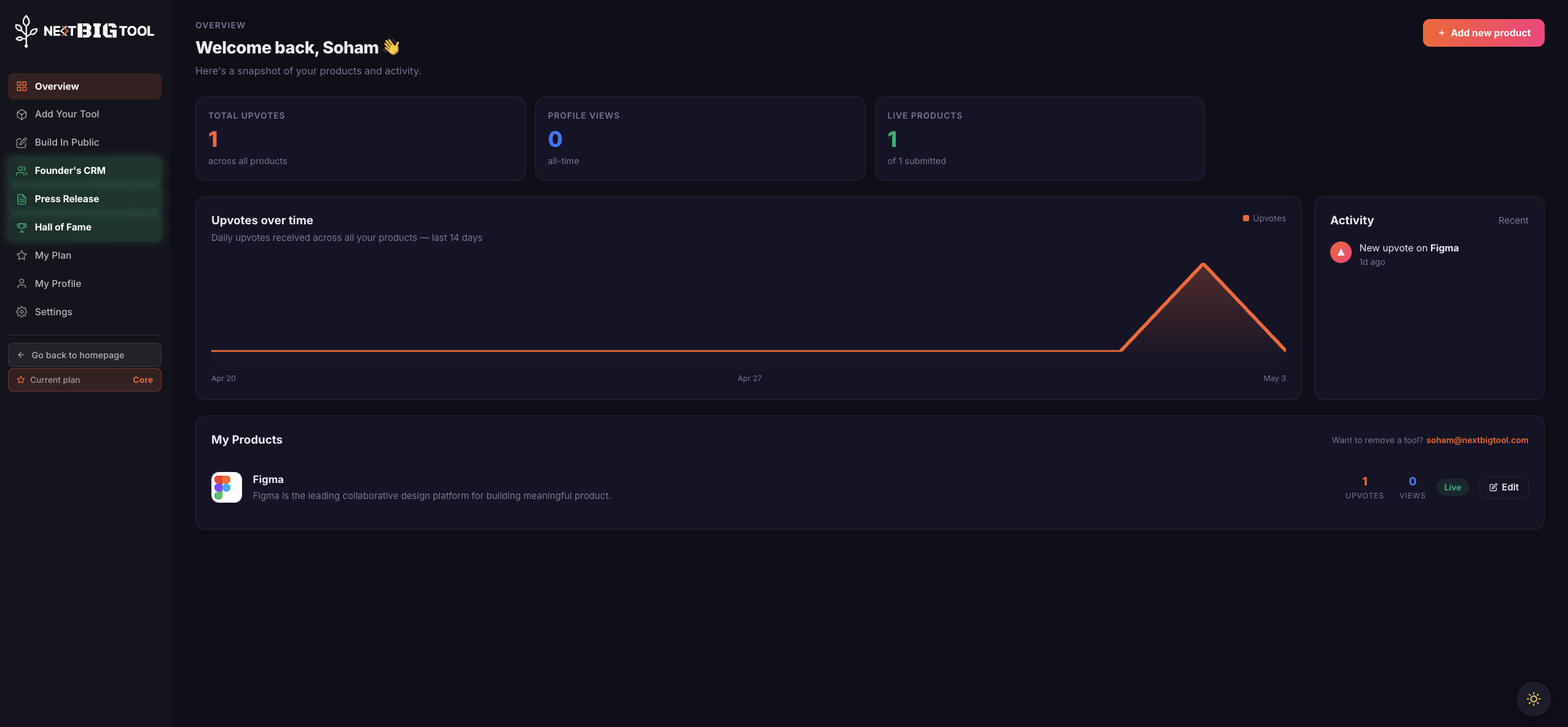
What separates NextBigTool from every other directory on this list is the Founder CRM, available on the Core plan at $49 per month (or $29 per month billed yearly). When someone upvotes or follows your product, you see their name, email, company, and job title. Those are warm leads, not anonymous clicks. No other product launch platform converts platform interest into named pipeline the way NextBigTool does.
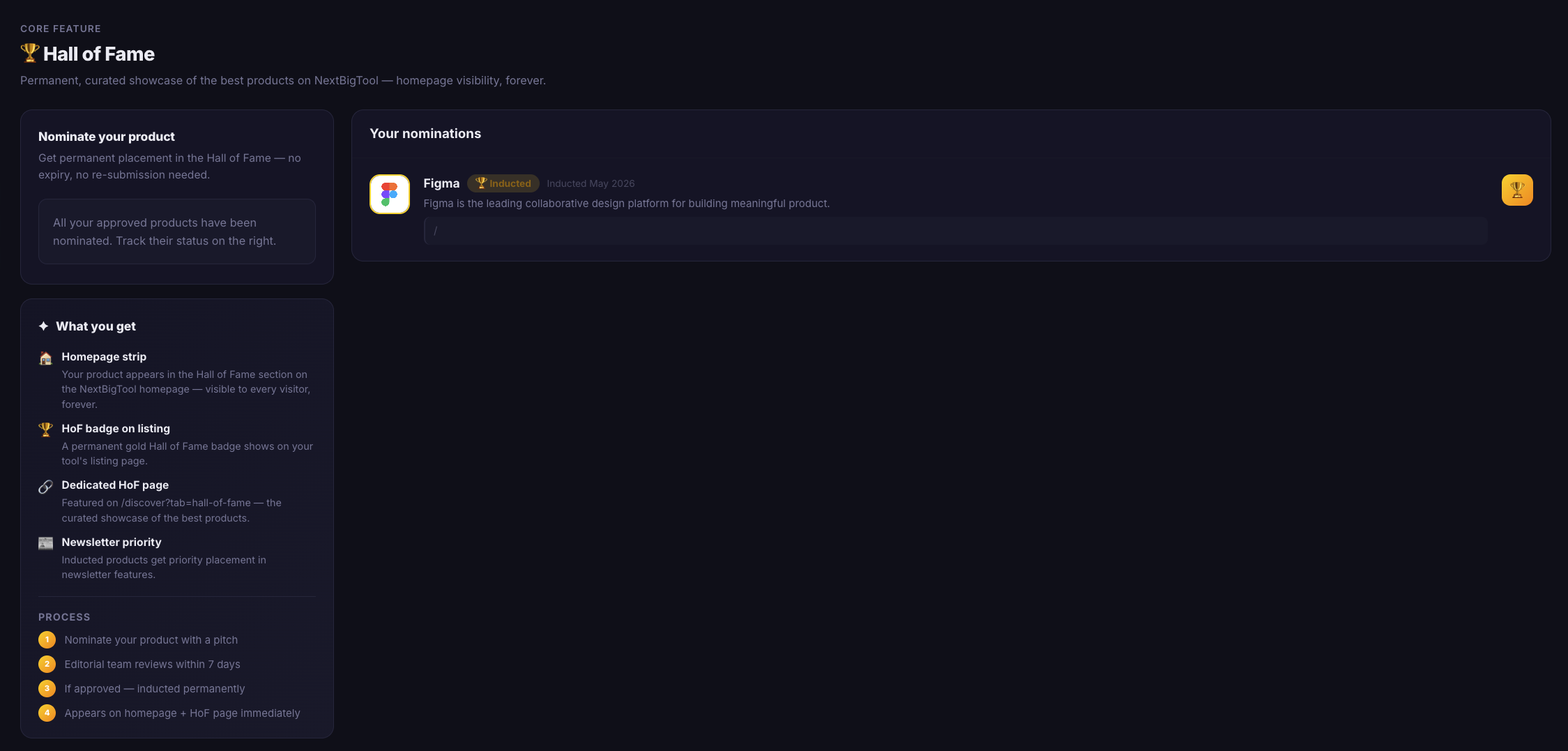
The Hall of Fame feature adds permanent placement for top-performing products, a category that does not exist on Product Hunt at all. And every Core plan includes a professionally written and distributed press release, which means your launch generates backlinks and media coverage beyond the directory itself. The free plan lets you list one product with a high-authority backlink and basic analytics, so there is no reason not to start.
2. BetaList: Best for Pre-Launch Feedback and Early Adopters
BetaList is the right platform when your product is not fully launched yet. It connects founders with a curated community of early adopters who actively seek beta access to products still in development. Founders typically use BetaList two to three weeks before their main launch to validate messaging, collect signups, and gather honest feedback before a broader release.
Expect 20 to 150 signups depending on your niche, visuals, and how clearly you explain the problem you solve. The audience is self-selected for curiosity and tolerance for rough edges, which makes their feedback more useful than generic upvotes. BetaList does not generate the same volume as a top-10 Product Hunt finish, but the quality of attention is meaningfully higher for pre-launch products. It is particularly strong for consumer apps and early-stage SaaS tools with a clear, relatable use case.
3. Indie Hackers: Best for Community-Driven Long-Term Traction
Indie Hackers is not a launch directory. It is a community of bootstrapped founders who share revenue numbers, growth tactics, and hard-earned lessons in public. The platform rewards consistency and genuine contribution, not a single launch day post. If you show up, share your journey, and engage with other founders, you build an audience that follows your product because they trust you, not because an algorithm surfaced you for 24 hours.
The best strategy on Indie Hackers is to start posting before your launch. Write about the problem you are solving, share early traction numbers, ask for feedback on your pricing page. By the time you announce publicly, you already have a warm audience. This makes Indie Hackers a strong complement to any launch on a directory platform. It compounds over weeks and months, not hours. Niche B2B tools in particular benefit from Indie Hackers because the audience skews operator and founder, exactly who buys this type of software.
4. Hacker News (Show HN): Best for Developer Tools and Technical Products
Hacker News Show HN posts remain one of the highest-quality traffic sources available to any indie founder, provided your product resonates with a technically sophisticated audience. A successful Show HN can generate thousands of visits in hours, detailed technical feedback you cannot get anywhere else, and backlinks from a DR 91 domain. The catch is that the audience is unforgiving of hype, thin products, and marketing-speak.
To succeed on Hacker News, your product needs to do something genuinely interesting or solve a real pain in a clever way. Lead with the problem, not the product name. Engage with every comment personally and immediately after posting. Avoid adjectives. The Show HN format works best for developer tools, open-source projects, technical SaaS, and anything that can be explained precisely and honestly. For consumer apps or tools targeting non-technical buyers, the conversion rate is typically low even when traffic is high.
5. SaaSHub and Peerlist: Sustained Discovery for B2B and Builder Audiences
SaaSHub earns its place in any launch strategy through search-driven discoverability rather than a launch-day spike. The platform functions as a structured directory where users compare SaaS tools, read reviews, and explore alternatives. A well-optimized SaaSHub listing generates organic traffic from buyers who are actively evaluating software in your category, often for months or years after you submit. It is particularly strong for B2B SaaS tools where the buying process involves comparison and research rather than impulse.
Peerlist targets a different slice of the builder community: designers, developers, and technical founders who want to showcase their work and their products in the same place. The Peerlist Launch feature lets you present your product to an engaged, growing community of creators and tech professionals. The audience is smaller than Product Hunt's but significantly more engaged, and the platform is growing fast. Use it when you want thoughtful peer feedback and visibility with technical decision-makers. List your tool across multiple platforms to maximize the reach of each launch.
Frequently Asked Questions
Q. What is the best Product Hunt alternative for indie founders in 2026?
NextBigTool is the best Product Hunt alternative for indie founders in 2026. It gives products permanent, evergreen visibility rather than a 24-hour ranking window, and the Founder CRM on the Core plan converts platform interest into named, contactable leads with names, emails, company details, and job titles. No other launch platform on this list turns upvotes into warm sales pipeline.
Q. Is Product Hunt still worth using in 2026?
Product Hunt is still worth using for consumer-facing apps and well-connected teams with an existing audience to mobilize on launch day. For most bootstrapped and niche B2B products, a multi-platform strategy using alternatives like NextBigTool, BetaList, and Indie Hackers generates more durable traffic, better conversion rates, and more qualified early adopters than a Product Hunt launch alone.
Q. What platforms give the best SEO backlinks when you launch a product?
Platforms that provide strong SEO backlinks for product launches include NextBigTool, BetaList, SaaSHub, and Hacker News. NextBigTool's free plan includes a high-authority dofollow backlink. SaaSHub and BetaList are both high-DR domains that index product pages consistently. Hacker News carries a DR of 91 and any successful Show HN post generates lasting link equity.
Q. How many platforms should you launch on at once?
Most indie founders see the best results launching on 5 to 10 platforms in the first month after shipping. Start with one core platform where you put genuine effort into the listing, then distribute across directories and communities over the following weeks. Staggering launches also extends the window of new-traffic spikes rather than concentrating everything into a single day.
Q. What is the difference between a launch platform and a product discovery platform?
A launch platform focuses on creating a moment of visibility around a specific release date, usually through upvotes, daily rankings, or featured placements. A product discovery platform like NextBigTool is built for ongoing discoverability, where buyers find tools through search, browse, and curated categories long after any launch event. The best strategy uses both, since launch moment plus persistent discoverability compounds over time.
Stop Optimizing for Launch Day. Build for Compounding Discovery.
A single great launch day means nothing if your product disappears the next morning. The founders gaining real traction in 2026 treat launch as the beginning of distribution, not the end. They stack platforms with different audience profiles, build in public across communities, and make sure their product stays findable weeks and months after the initial push. NextBigTool is built specifically for that compounding model, with evergreen listings, a Founder CRM that turns interest into pipeline, Hall of Fame placement for top products, and a press release included with every Core plan. If you are ready to stop relying on a 24-hour window and start building visibility that actually compounds, submit your tool to NextBigTool today.